

Finding Shelter
BY MAGGIE MORRIS
Dossier Issue 80, March 22, 2026
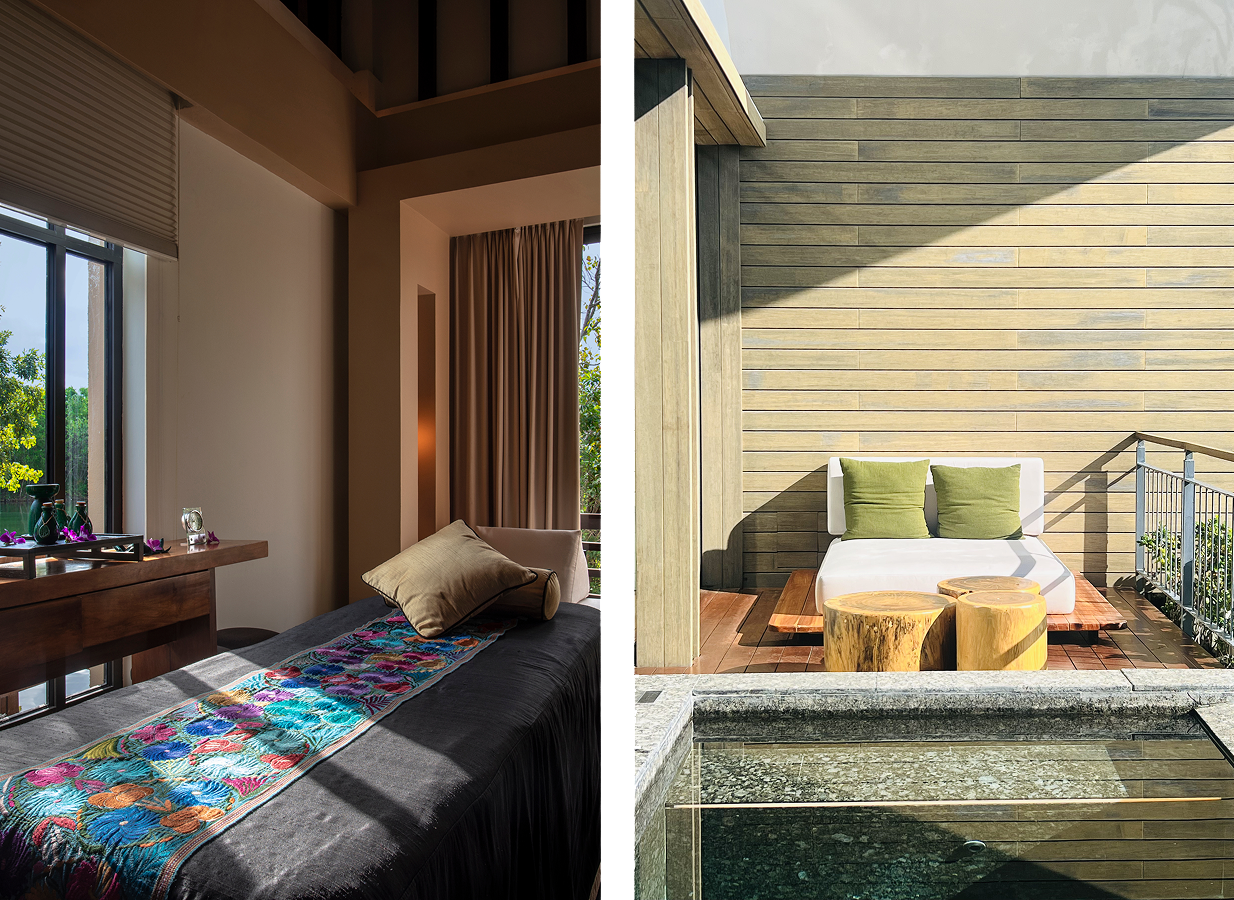
I showed up for the Rainforest Experience at Banyan Tree Mayakoba, just south of Cancun, Mexico, coated in mosquito repellant and wearing hiking shoes. But when I met my guide, she handed me a spa robe and sandals before leading me to a labyrinth of themed showers, saunas, and steam rooms.
I began the ritual by walking across a pathway of smooth stones while alternating warm and cool water rained from above. The path led to an aromatic steam room, where I scrubbed myself with turmeric, local honey, tamarind, and sesame — a paste that smelled so fantastic I wanted to eat it. The heat opened every pore of my skin and, as I watched sweat bead and roll off my body, I realized how long I’d been holding tension I couldn’t even name. A cold rinse shocked me awake, a reset I felt in my lungs.
Next came another steam room, this one infused with salty air, where I smothered myself in a fresh avocado body mask and hair treatment. Another cold rinse was followed by the heat of a Finnish sauna, finished off with crushed ice that I pressed into my skin.
The Vitality Pool, a cavern-like bath lit with flickering candles, was the grand finale. Underwater lounge chairs gently massaged my back while Jacuzzis offered therapeutic jets. The noise in my mind eventually quieted, and I began to laugh. My limbs felt loose, my skin was silky, and the tired, brittle person who'd stepped into the labyrinth was gone. I couldn't remember the last time I’d felt so recharged.
The experience was part of the property’s annual Women’s Retreat, designed “for those who wish to reconnect with themselves, nourish their spirit, and share with like-minded women in a space of peace and transformation.” The brand’s founder, Claire Chiang, and her daughter, deputy CEO Ho Ren Yung, were part of this group. Hearing them speak made the spa experience click. It wasn’t just pampering. It was about defining self-care, slowness, and presence as forms of power rather than indulgence.
Chiang founded Banyan Tree in 1994, with the symbolism of its namesake in mind: deep roots, cultural continuity, and communal gathering beneath the shelter of a generous canopy. Banyan Tree’s properties — now stretching from Mexico to the Maldives — are likewise evolving sustainable luxury by preserving local ecosystems and cultural integrity without sacrificing experience. They’re all grounded, elegant, and conscious, but they never feel austere.
Similarly, Yung spoke about leadership as something relational and circular, rather than hierarchical, an ecosystem rather than a pyramid. The brand invests in local artisans, invites community members into programming, and celebrates craft and culture in ways that feel lived rather than performed. The nightly turn-down gifts left in my room — a hand-carved bookmark, a glass heart pendant — came from local makers and carried their stories.
What I took home was not just those gifts or a spa-induced afterglow (though I would happily fly back to Mexico anytime just for that experience). It was the realization that personal restoration is not extravagance but a form of capacity building. To lead, create, and care for others, you have to know how to return to and strengthen yourself. And, sometimes, that return begins slowly, with water: cleansing, scrubbing, polishing until the shine reemerges.