

Thinking Absurd:
Maison Heler Metz
BY MAGGIE MORRIS
Dossier Issue 92, June 28, 2026
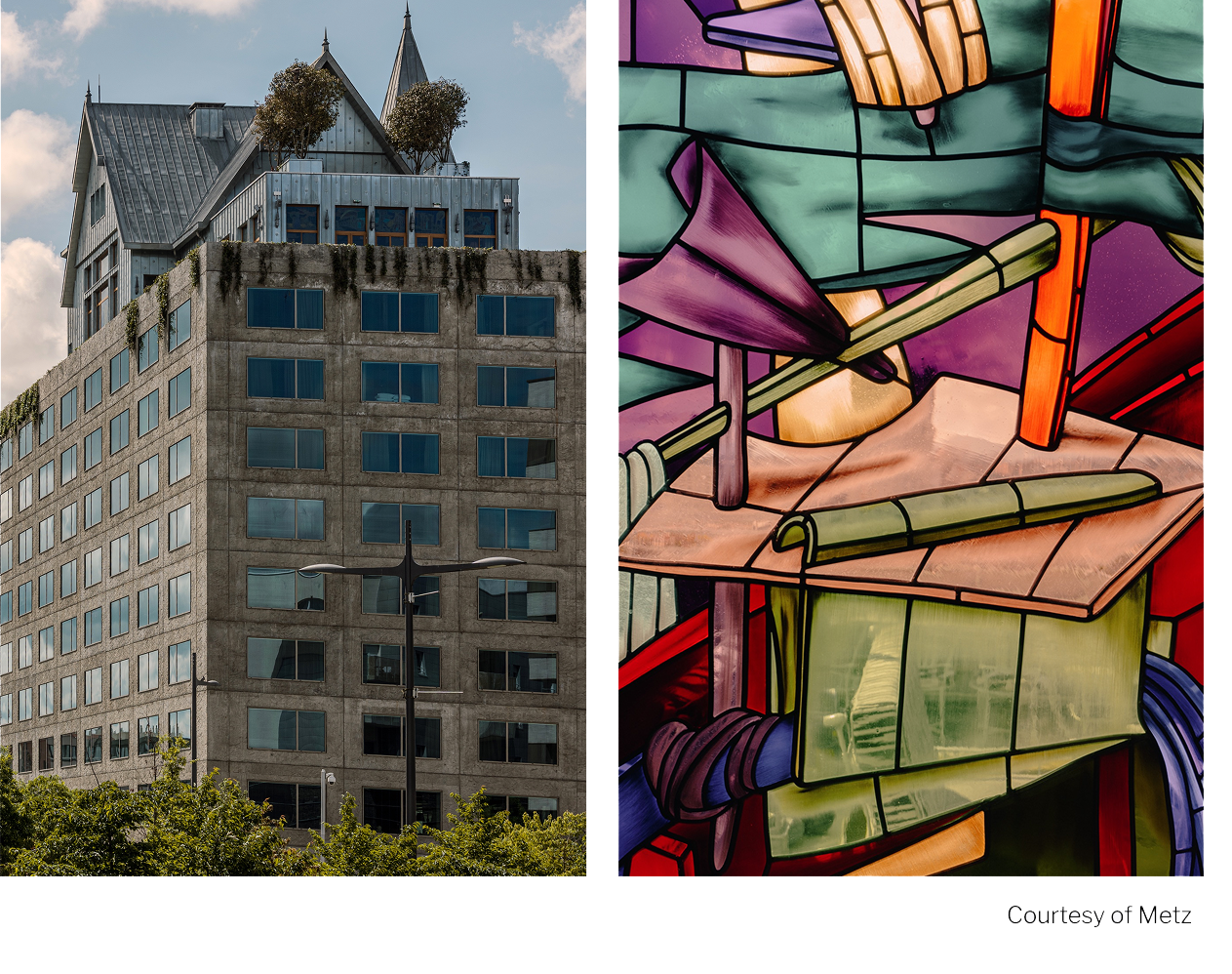
Philippe Starck’s Maison Heler Metz, part of the Curio Collection by Hilton, rises like a dream that has insisted on becoming reality. The fantastical 104-room hotel is both familiar and impossible: a 19th-century Lorraine mansion perched neatly atop a brutalist block of concrete and glass, as if spirited from another time and bolted firmly into place.
“Surrealism is only open symbols,” Starck has said. “When nothing is fixed, anything can happen.” At Maison Heler, that openness takes architectural form. The house on the roof is not a joke or a provocation. It's a declaration that the world can contain multiple truths at once: memory and futurism, fantasy and function, French and not quite French.
Starck’s first ground-up architectural project, more than a decade in the making, began not with blueprints but with a poetic novella, LaVie Minutieuse de Manfred Heler (The Meticulous Life of Manfred Heler), written by Starck. Accordingly, arriving at the hotel is like stepping into the fictitious world of the book’s protagonist, a solitary orphan.
Reception feels like a stage set for dreaming; corridors are softly lit and deliberately disorienting, lined with Heler’s peculiar inventions. Bars and restaurants (two each) have their own moods, some bright and convivial with stained glass designed by Starck’s daughter, Ara, others hushed and velveted. Threaded throughout — tucked into corners, printed on key cards, hidden in wallpaper alcoves — are coded messages from Heler. Guests are not simply staying here; they’re inhabiting the character’s mind, surrounded by his odd objects and obsessive devotion to his beloved, Rose.
The hotel’s placement in Metz is no accident. This is a city accustomed to holding multiple realities in a single frame. Roman, gothic, baroque, art nouveau, and German imperial styles coexist, reflecting an identity that has been rewritten, overwritten, and stitched back together by history’s hand more than once
Word to the Wise … If Maison Heler invites you in, Metz itself pulls you out. A short walk from the hotel, the gothic Cathédrale Saint-Étienne presents the largest surface area of stained glass in the world, including contributions from Marc Chagall. And at the edge of the city center, Centre Pompidou–Metz offers Shigeru Ban and Jean de Gastines’ vision of contemporary culture, built from a lattice of timber curves and translucent membrane. Even the Michelin-starred restaurant Yozura, upstairs, feels like a dreamy observatory, its windows offering a wide panorama of the city.